Cristal

Carolina Cristal Ferreira, visual artist and cultural producer, her practice emerges from the intersection of art, listening, and subjective processes. With a background in psychology, she began her artistic journey in childhood, deepening her production from 2016 onwards, when she started to explore art as a tool for care and emotional processing.
She works across multiple mediums, with an emphasis on acrylic painting on canvas and watercolor on paper, as well as experimenting with collage, photography, installation, and audiovisual formats. Her work often incorporates interactive elements, inviting the audience to actively engage with the pieces and their emotional resonances.
Her research investigates subjectivity, intersectionality, and the relationships between race, gender, and capitalism, using personal experiences and internal tensions as creative material. Throughout her career, she has participated in group exhibitions and engaged in curatorial and cultural production projects, with highlights including her solo exhibitions “TÊMPORAS: entre o que vi e ouvi” (Temples: between what I saw and heard) (2024) and “Para alcançar os sonhos” (To Reach Dreams) (2025).
Her practice also extends into writing, both poetic and academic, understood as an inseparable part of her artistic work and her ongoing
investigation of the world.
Instagram: @ccristalina_
Photographs by Everson Verdião (@_everson)
Rafael Chá

Rafael Lino Maenza de Sousa, visual artist with a background in Environmental Management, his practice emerges from the intersection of art, perception, and socio-environmental issues. Since childhood, he has cultivated a close relationship with art and culture, frequently visiting museums and cultural centers in São Paulo, experiences that later became intertwined with his academic and professional path.
His engagement with artistic production takes shape more decisively in 2021, when he encounters the marbling technique. From this moment, he develops an authorial research in abstract art, further deepened within the context of Ateliê Casa Dois, where he also worked as a cultural producer and held his first solo exhibition, “Espesso e Real” (Dense and Real).
He primarily works with marbling on paper, creating abstract compositions that engage with specific themes, often developed in collaboration with clients who commission his works. His practice investigates art as a tool to confront the crisis of imagination, proposing new ways of envisioning the future through sensitivity, listening, and the materialization of individual and collective experiences.
His creative process is grounded in dialogue and immersion in the narratives, memories, and cultural references of each project, embracing chance as a fundamental element of both technique and image-making. In 2025, he presented the exhibition “Abstracionismo Ambiental” (Environmental Abstractionism), articulating art and the environment as inseparable fields, while also developing educational practices that integrate art, science, and technology across diverse social contexts.
Instagram: @cha.abstratos
Photographs from the artist's own collection.
SubVersiva
%20-%20Daiana%20Ter.jpg/:/rs=w:400,cg:true,m)
Daiana da Costa Terra, visual artist, researcher, and educator, her practice emerges from the intersection of collage, memory, semiotics, and racial issues. Graduated in Radio, Television and Internet from Universidade Anhembi Morumbi and in Visual Arts from UNESP Bauru, she began her path in the arts through cultural mediation, an experience that expanded her engagement with contemporary artistic languages and practices.
Her work is primarily developed through analog collage, using fragments from printed materials to construct new visual narratives shaped by personal experiences, collective memory, and intersectional research. Alongside collage, she also experiments with mixed media, video performance, artist books, and painting on fabric.
Her research investigates contemporary violences directed at Black and Indigenous bodies in Brazil, addressing coloniality, race, gender, and class through both sensitive and critical perspectives. Her works often articulate visual delicacy alongside political confrontation, proposing shifts in historically constructed imaginaries.
Throughout her trajectory, she has participated in solo and group exhibitions, including “Recortes da Memória” (Memory Fragments) and “Querência”, as well as exhibitions such as the 30th MAJ – Youth Art Exhibition at Sesc Ribeirão Preto and “Visualidade Simultânea 4” (Simultaneous Visuality 4).
Parallel to her artistic production, she develops collage and image literacy workshops in cultural and educational institutions, using art as a tool for creating new narratives and encouraging critical ways of seeing.
Her practice understands the artwork as a direct extension of her lived experiences and personal crossings, embracing art as a space of honesty, elaboration, and presence.
Instagram: @sub__versiva
Photographs by Luma Ruiz (@lumachiararuiz)
Bruno Hatanaka
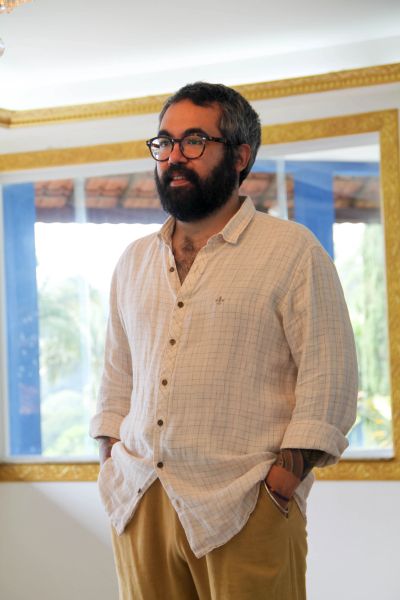
Bruno Faria Hatanaka, self-taught visual artist, his practice originates in drawing during childhood, consolidating over time through a process of reconnection with his own identity. This path naturally led him from drawing and printmaking to wood sculpture, a medium that now occupies a central place in his work.
He works across multiple mediums, including watercolor, digital art, linocut printmaking, and sculpture, exploring the specific qualities of each technique as forms of sensitive and material expression.
His research revolves around popular faith and the human dimensions present in Afro-diasporic spiritual practices, investigating symbols, gestures, and narratives that intersect spirituality and everyday life. His work seeks to give form to these experiences, often engaging with the need for materiality inherent to certain images and meanings.
His creative process begins with images and intuitions that may move across different media before reaching their final form. The work “O berço de Oxum” (Oxum’s Cradle) exemplifies this trajectory, originating as a digital painting and later unfolding into a wood sculpture through a process that involves modeling, material preparation, and the search for form within the matter itself. In his paintings and prints, gesture follows a more continuous dynamic, influenced by movement, circularity, and the rhythms present in Candomblé practices and in life.
Instagram: @brunofhat
Photographs from the artist's own collection.